Every growing business eventually asks the same question.
Do we invest in SEO, or do we put the budget into Google Ads?
It usually comes up at a difficult moment.
Leads have slowed, the board wants a plan, and someone has just quoted two very different numbers for two very different approaches.
The honest answer is that they solve different problems.
One buys attention today. The other builds an asset that keeps working.
This guide compares both on cost, speed, control and long term return, then gives you a clear way to decide which one your business should lead with.
SEO vs Google Ads: The Short Answer
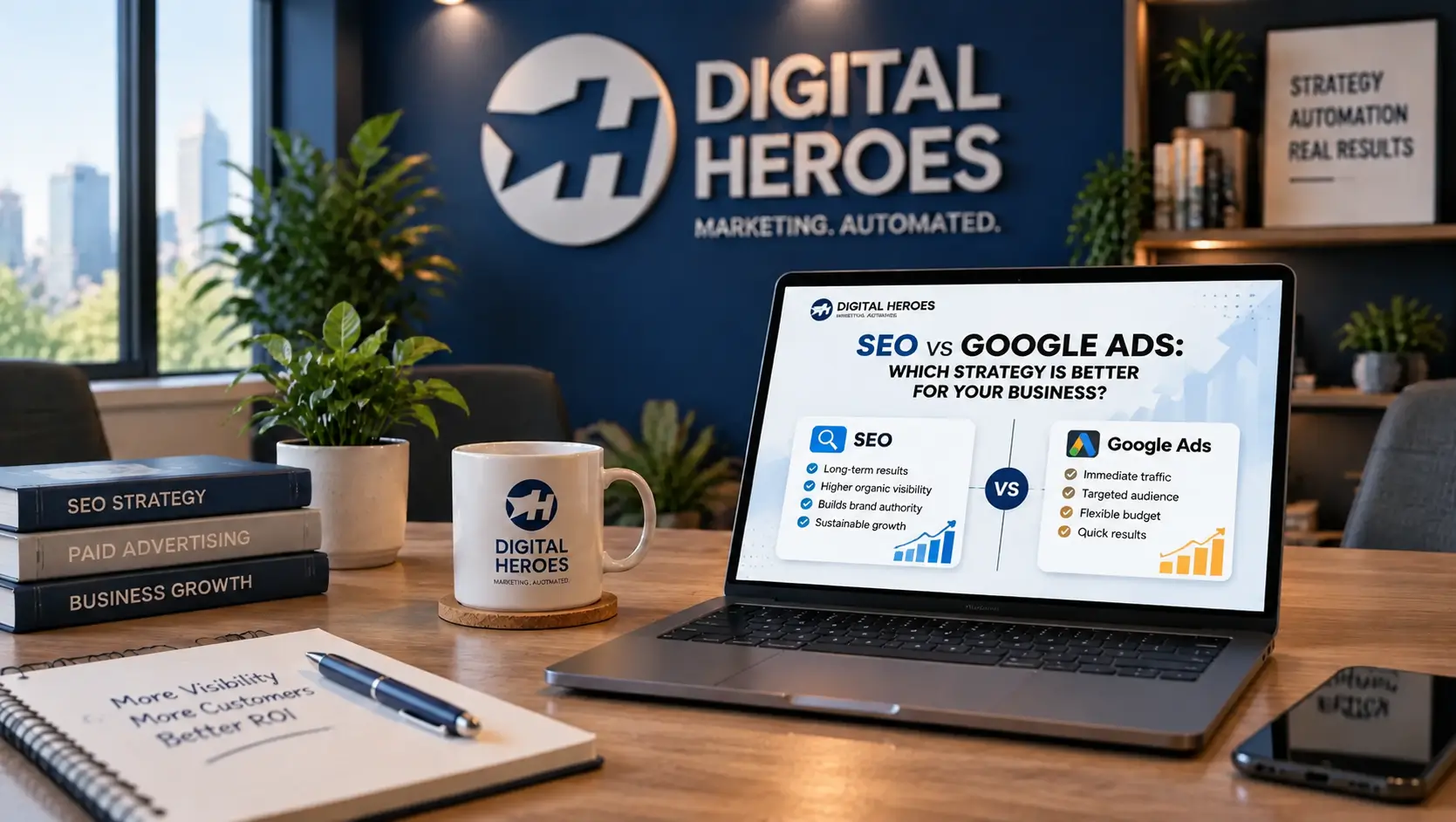
Google Ads is better when you need leads quickly, want tight control, or are testing a new offer.
SEO is better when you want lower cost per lead over time and visibility that keeps working after the budget stops.
Most growing businesses get the best result by starting with ads and building SEO underneath.
Neither channel is universally better. The right choice depends on your timeline, your budget and how competitive your market is.
If you take one thing from this article, take this.
✅ Choose Google Ads when the constraint is time
✅ Choose SEO when the constraint is budget over the long run
✅ Run both when you can afford to, because they make each other cheaper
What SEO Actually Does for Your Business
SEO earns visibility in unpaid search results by making your site technically sound, genuinely useful and trusted by other sites.
You do not pay per click. Instead you invest in work that compounds, so a page published this quarter can still be producing enquiries in two years without further spend.
SEO covers three kinds of work that only pay off together.
✓ Technical SEO, so search engines and AI crawlers can reach and understand your pages
✓ Content and on page optimisation, so each page answers a real question well
✓ Authority building, through relevant links, consistent brand information and credible authors
The economics are what make SEO attractive to smaller businesses.
You pay for the work once. The traffic that follows does not carry a per click cost, so your cost per lead falls as pages mature.
The catch is patience. Most sites see meaningful movement within three to six months, and our guide on how long SEO takes to show results sets out what to expect at each stage.
What Google Ads Actually Does for Your Business
Google Ads buys placement in search results and across Google properties, charging you each time someone clicks.
It delivers traffic on day one, gives you direct control over targeting and budget, and produces fast, clear data.
The moment you pause the campaign, the traffic stops with it.
Paid search suits situations where waiting is not an option.
✓ Immediate visibility for commercial and transactional searches
✓ Control over geography, device, audience and budget
✓ Fast feedback on messaging, offers and landing pages
✓ Remarketing to people who have already visited your site
There is one shift worth understanding before you plan a budget.
Google Ads is now largely automated. AI Max for Search left beta in April 2026 and is the default for new Search campaigns, which means the system decides far more than it used to.
That changes what good management looks like. Our beginner guide to running smarter PPC campaigns covers the setup, and how to maximise ROI from search advertising covers what to do once spend is live.
SEO vs Google Ads: A Side by Side Comparison
The two channels differ most on speed, cost behaviour and what happens when you stop.
Google Ads delivers immediately but costs the same or more each month.
SEO takes months to build but gets cheaper per lead over time, and keeps delivering after active work pauses.
The table below is the fastest way to see the trade off.
| Factor | SEO | Google Ads |
| Speed to first results | Three to six months in most markets | Same day |
| Cost model | Fixed investment in work, no cost per click | Pay for every click, continuously |
| Cost over time | Cost per lead falls as pages mature | Cost per click tends to rise with competition |
| When you stop | Traffic declines gradually over months | Traffic stops immediately |
| Control over targeting | Indirect, through content and intent | Direct, through campaign settings |
| Data and feedback | Slower, harder to attribute precisely | Fast and granular, within privacy limits |
| Best suited to | Research stage demand, trust, compounding growth | Immediate demand, launches, testing |
| AI search impact | Can earn citations inside AI answers | Ads now appear inside AI Overviews |
Read the last row carefully. It is the newest part of this comparison and the part most businesses have not priced in yet.
How Much Does Each Channel Cost?
SEO is priced as a monthly investment in work: technical fixes, content and authority building.
Google Ads has two costs, the media spend itself and the management on top.
The useful comparison is not monthly cost but cost per qualified lead, measured over at least six months.
Comparing headline prices leads most businesses to the wrong decision.
A paid campaign can look cheaper in month one and considerably more expensive by month eighteen, because every lead still carries a click cost.
When you build the comparison, include these:
- Media spend, for paid only
- Agency or in house management time, for both
- Content production, for SEO
- Technical development time, which both channels need
- Landing page and conversion work, which both channels depend on
Then divide by qualified leads, not by clicks or sessions.
❌ Comparing SEO cost per month against ad spend per month
❌ Counting every form fill as a lead of equal value
❌ Judging SEO on a three month window, which is shorter than its payback period
How Quickly Will You See Results?
Google Ads can produce enquiries within days, though campaigns usually need two to four weeks of data before performance settles.
SEO typically shows movement in three to six months, with meaningful compounding after twelve.
Technical fixes are the exception and can lift rankings within weeks.
This is the difference that decides most arguments about budget.
If your business needs leads this quarter to survive, SEO alone is the wrong answer. It will get there, but not in time.
If you have twelve months of runway and a competitive market, relying only on ads means paying for every single customer indefinitely.
A realistic sequence for a growing business looks like this:
- Months one to three: run ads on your highest intent terms, fix technical SEO issues in parallel
- Months three to six: publish content around the questions your ads data shows people actually ask
- Months six to twelve: organic rankings begin carrying part of the load, so paid budget narrows to the terms that convert best
Which One Should Your Business Choose?
Choose based on your situation rather than on principle.
New sites and urgent targets point to Google Ads.
Limited budget with a longer horizon points to SEO.
Established sites with existing content usually get the best return from SEO first, with paid used for the bottom of the funnel.
The table below covers the situations we see most often.
| Your situation | Lead with | Why |
| New website, no rankings, need leads now | Google Ads | Nothing else produces visibility on day one while the site has no authority. |
| Limited budget, twelve month horizon | SEO | Every pound goes into an asset rather than into clicks you rent. |
| Seasonal or event driven demand | Google Ads | You can switch spend on and off to match the season precisely. |
| Established site with existing content | SEO | Improving pages that already rank is usually the cheapest growth available. |
| Local service business | Both, weighted to local SEO | Local intent converts well organically, and paid covers the gaps. |
| Very high click costs in your market | SEO, with narrow paid targeting | Organic visibility is often the only sustainable route when clicks are expensive. |
| Testing a new offer or market | Google Ads | You get a clear answer in weeks rather than quarters. |
If your customers search by location, local intent deserves its own plan. Our guide to local SEO explains why national rankings do not automatically win local searches.
How AI Search Has Changed the Comparison
AI answers now sit above both channels.
Ads appear inside AI Overviews, and organic pages compete to be cited rather than simply ranked.
Informational searches increasingly resolve without a click, which pushes paid competition towards a smaller pool of high intent queries and raises the value of being the source an AI quotes.
This affects both sides of the comparison, and not equally.
On the paid side, more budget now chases fewer clicks, because the questions that used to send traffic are answered on the results page.
On the organic side, the goal has widened from ranking to being cited. Our article on zero-click searches covers how to keep winning traffic when the answer appears above the results.
What this means practically:
✅ Structure content so an AI system can lift a correct answer from it
✅ Keep paid and organic messaging consistent, because AI answers draw on your site either way
✅ Expect paid clicks on informational terms to get less efficient over time
The organic half of this shift is covered in more depth in our guide to AI search optimisation.
When Running Both Works Best
SEO and Google Ads work better together than apart.
Paid campaigns reveal which keywords and messages actually convert, which makes content planning far more accurate.
Organic rankings then reduce how much you need to bid on those same terms, and owning both listings increases the share of clicks you capture.
The combination is not simply about spending more. It is about each channel making the other cheaper.
✅ Use paid search term data to decide what content to write next
✅ Test headlines and offers in ads before committing them to landing pages
✅ Pull back paid spend on terms where you have earned strong organic positions
✅ Keep paid running on your highest intent commercial terms even when ranking well
Bringing both together under one strategy is usually where an online marketing agency earns its fee, because the two channels are normally managed by different people who never compare notes.
Common Mistakes When Choosing Between SEO and Google Ads
Most businesses lose money on the decision rather than on the channels.
They judge SEO on a timeline too short to be fair, treat paid spend as a permanent tax, or run both without ever comparing the data.
Each of these is avoidable with clearer measurement from the start.
The mistakes below account for most of the wasted budget we see.
❌ Stopping SEO at month four, just before the payback period begins
❌ Running ads with broken or duplicated conversion tracking, so nothing can be judged fairly
❌ Treating the two channels as competitors for the same internal budget
❌ Choosing based on what worked for a competitor in a different market
❌ Ignoring landing page quality, which limits both channels equally
❌ Sending paid traffic to a page that has never been tested for conversion
Final Thoughts: It Is Rarely One or the Other
The question is not which channel wins. It is which one your business needs first, and how soon the other should follow.
Google Ads solves an immediate visibility problem. SEO solves a long term cost problem.
Businesses that treat them as one search strategy consistently outperform those that pick a side.
Start with your constraint.
If time is short, buy visibility now and build the organic foundation underneath it. If budget is the limit, invest in SEO and use paid sparingly on the terms closest to a sale.
Either way, measure cost per qualified lead rather than clicks, and give each channel a fair window before judging it.
Not Sure Which Way to Go? Start With the Data.
The right answer depends on where you already stand in search, and most businesses have never seen that clearly.
A free SEO and AI Search report from Digital Heroes shows your current organic performance, your visibility across AI powered search, and where paid spend is filling gaps that organic could cover more cheaply.
Request your free report and we will talk you through what it means for your budget. Book a free discovery call whenever you are ready.
Authors: Ivo & Teo & Les
Author: Ivo Paschold
Ivo Paschold is the Founder & Managing Director of Digital Heroes, with nearly two decades in digital marketing. From launching his first e-commerce business in 2007 to building global remote agency Digital Heroes, he helps brands grow through clear digital marketing strategy, planning, and service delivery as promised.

Author: Teo
Teo is a Senior SEO & AI Search Manager and Web Designer & Developer with over 15 years of experience. He specialises in technical SEO, GEO, AEO, high-performing websites, and AI-powered automation that support long-term growth across global markets and diverse industries.

Author: Les
Les is a Google Ads Expert at Digital Heroes, specialising in paid search strategy, campaign management, and optimisation. He helps businesses drive qualified traffic, increase conversions, and maximise their advertising investment through data-driven campaigns.

Frequently Asked Questions
1. Is SEO better than Google Ads?
Neither is better in every case. Google Ads wins when you need results quickly or want precise control, while SEO wins on cost per lead over the long term and keeps delivering after spend stops. The right choice depends on your timeline, budget and how competitive your market is.
2. Which is cheaper, SEO or Google Ads?
SEO is usually cheaper over a two to three year view, because you are not paying for every click. Google Ads can be cheaper in the first few months, since there is no waiting period. Compare them on cost per qualified lead across at least six months rather than on monthly invoices.
3. How long before SEO delivers more than paid ads?
Most businesses see organic take a meaningful share of enquiries between six and twelve months, depending on competition and how much content already exists. Technical improvements can show results within weeks, while authority building and content clusters compound over a year or more.
4. Can I run SEO and Google Ads at the same time?
Yes, and it usually produces the best result. Paid campaigns show you which keywords and messages convert, which makes content planning far more accurate. Strong organic rankings then reduce how much you need to bid on those same terms.
5. Should a small business start with SEO or Google Ads?
If the website is new and leads are needed soon, start with Google Ads on your highest intent terms while fixing technical SEO in parallel. If there is budget pressure but time to wait, start with SEO. Avoid splitting a small budget thinly across both at once.
AI QUICK ANSWER Google Ads is better when you need leads quickly, want direct control over targeting, or are testing a new offer, because it delivers traffic on day one but stops the moment you pause spend. SEO is better for lower cost per lead over time and visibility that keeps working without ongoing budget. Most growing businesses start with ads and build SEO underneath.